InductaLink develops the universal magnetic interface for power, data and latching in autonomous and modular systems operating in extreme environments: defence, naval and subsea, space and advanced industry.
When two modules approach or touch, the system transfers energy, exchanges data and holds a mechanical latch, all without conventional electrical contacts. Transfer is regulated dynamically through asynchronous magnetic-flux control, adjusting frequency and pulse width to the receiver's state.
Full induction through magnetic flux, with no electrical contacts. Energy rate modulated to the receiver's demand, and bidirectional flow.
Bidirectional link over the magnetic coupling itself, simultaneous with power: identification, configuration, telemetry and control. Roadmap towards industrial buses and higher bandwidth.
Data travels through the physical coupling itself, very short-range and highly localised: there is no radio link to intercept or jam and, by design, emission into the environment is minimal. Key in defence and in payloads carrying sensitive information.
Magnetostatic anchoring with no screws or external moving parts. Energy is used only to engage or release: once latched it holds with no power, even if power is lost.
The receiver identifies itself and the transmitter adapts transfer to its state. Heterogeneous devices on one common base, exchangeable live.
No exposed contacts: nothing to oxidise, foul or wear. Designed for the marine environment, planetary settings and sterilisable equipment.
Each module carries a ferromagnetic core, a winding and a processor. When the two touch, magnetic flux flows through both cores and carries energy and data with no electrical contact at all. The transmitter does not run at a fixed frequency: it adapts its pulses in real time to what the receiver reports.
Direct contact with alignment guides. Magnetostatic anchoring holds both modules together.
The receiver identifies itself and reports its state (charge, voltage, temperature).
Energy pulses tuned to actual demand. If the receiver is depleted, it is woken up first.
Bidirectional data over the same coupling: configuration, telemetry, control.
Hot-swap and plug-and-play: no screws, no external moving parts.
The same architecture scales from watts to kilowatts; each configuration sets voltage, power and payloads for its segment.
Miniaturised scientific instruments and sensors; several secondaries on a single primary.
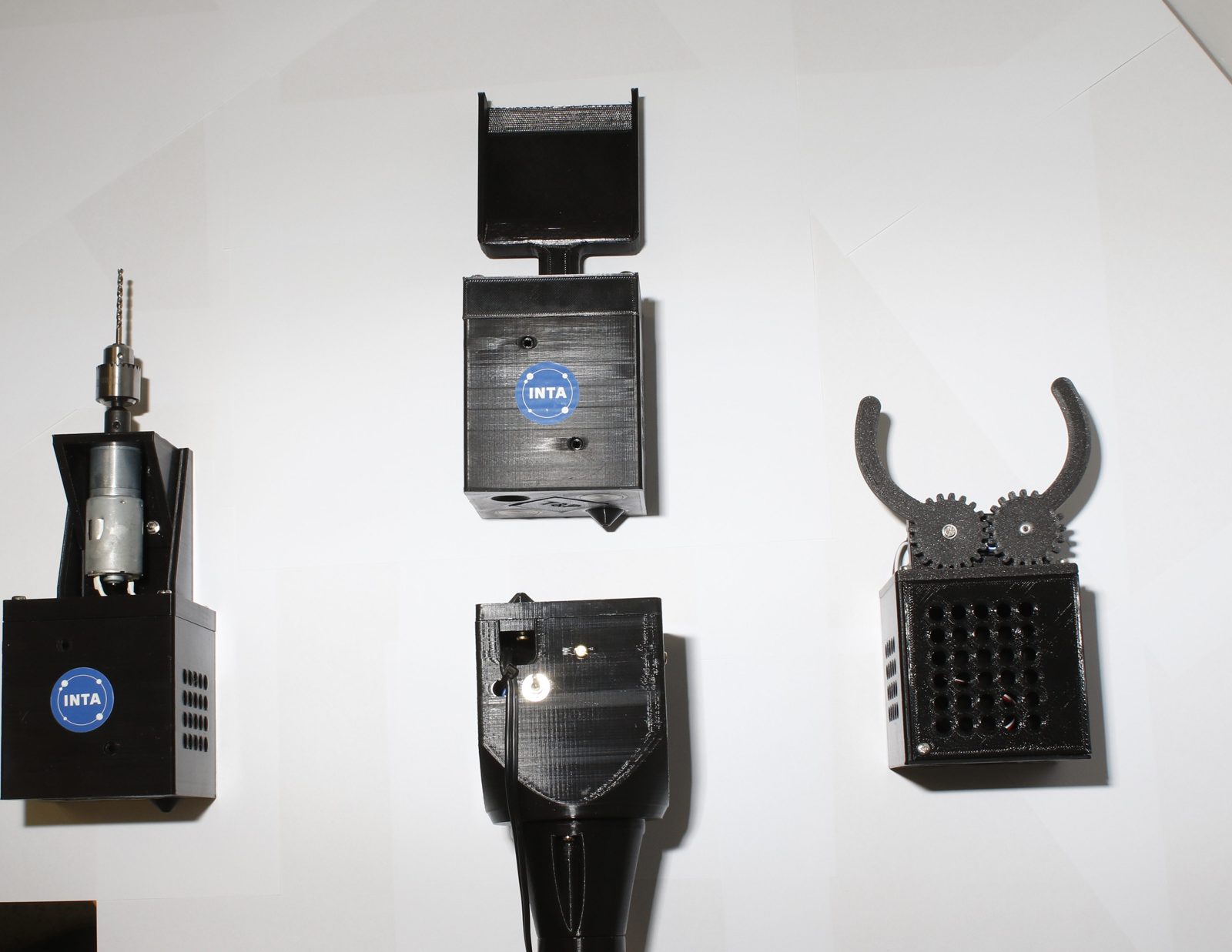
Swappable tools and payloads: gripper, drill, scoop, instrument. Compact format: modules of about 8 × 8 cm and under 1 kg for the pair.
Main power supply for autonomous robots and vehicles; receiver voltage and current data.
Status: functional prototypes validated in the laboratory, with no appreciable degradation over the coupling cycles performed. Ongoing: scale-up to 2.5 kW and validation in a relevant environment (real immersion, thermal vacuum, vibration, electromagnetic compatibility, lifetime and misalignment tolerance).
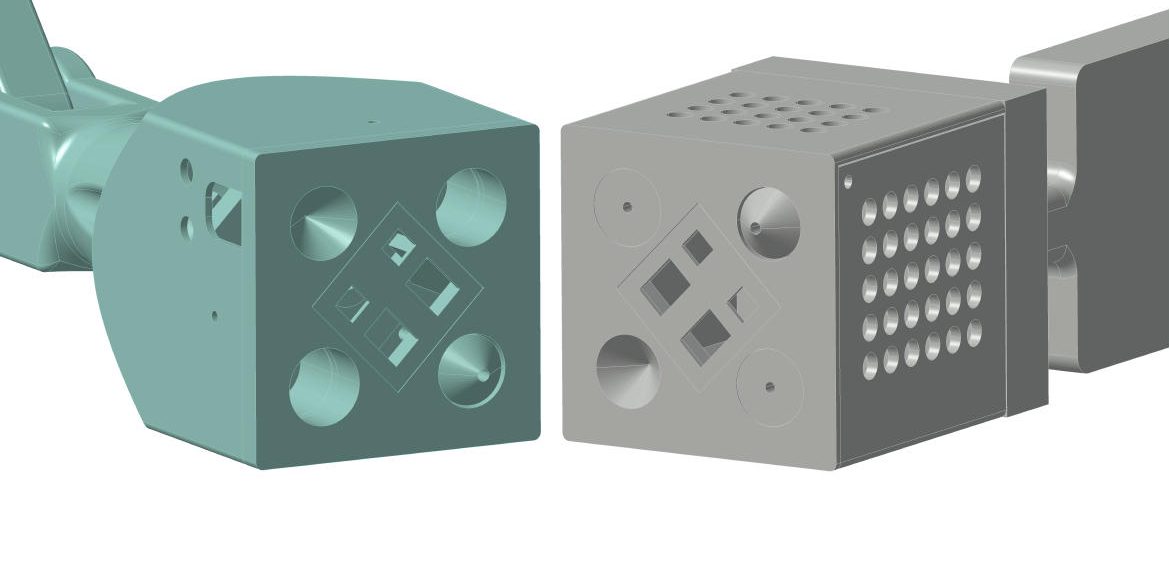
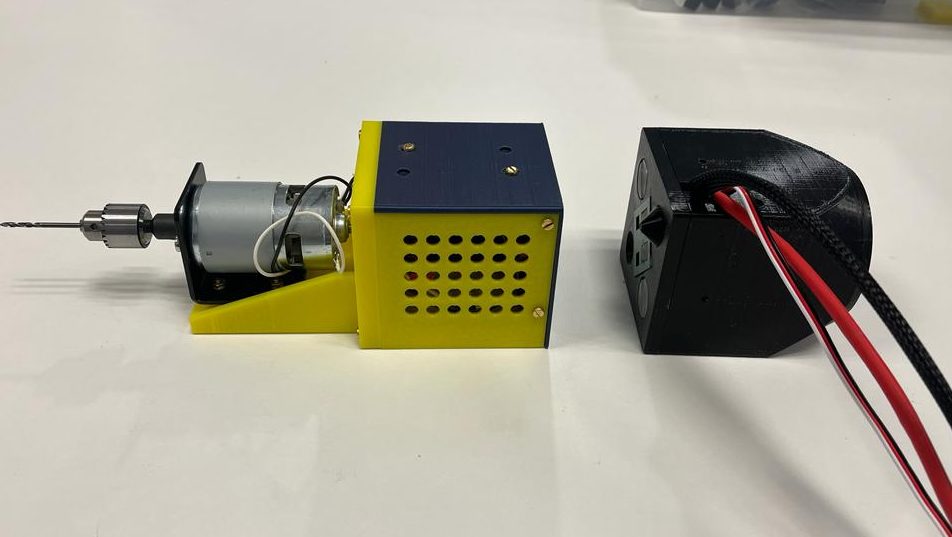
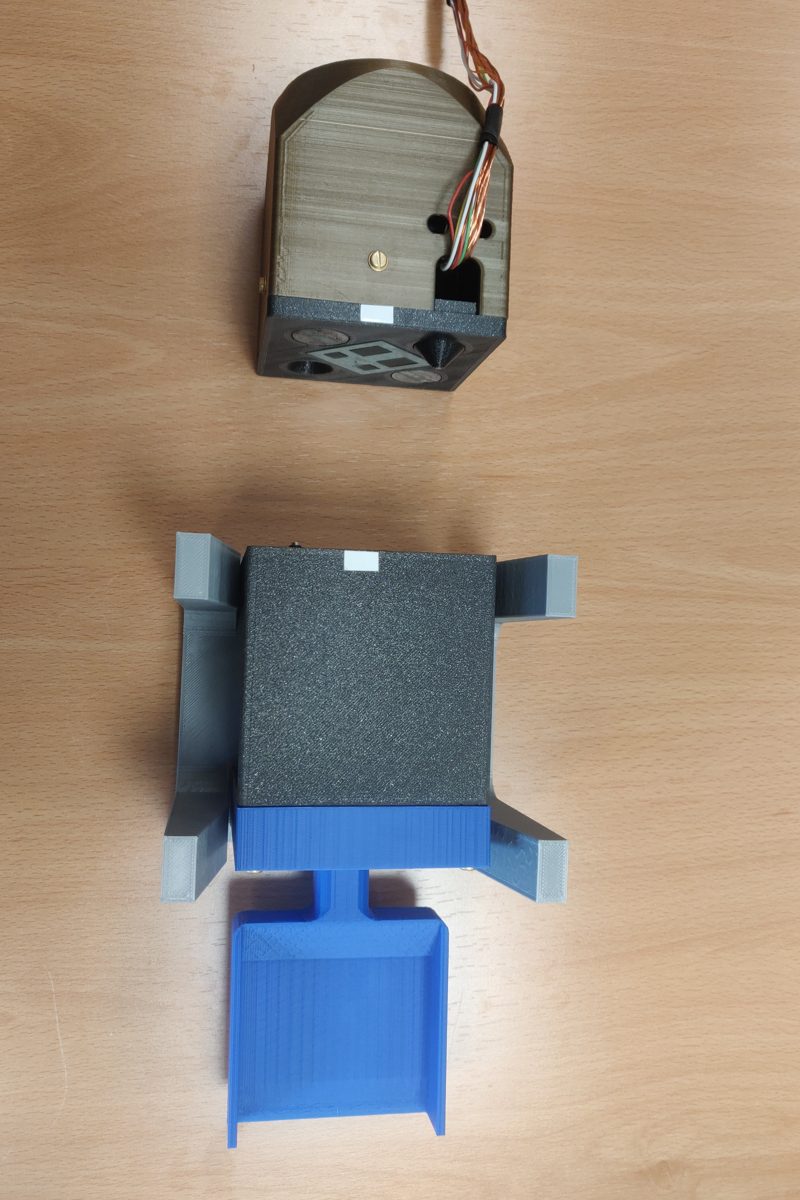
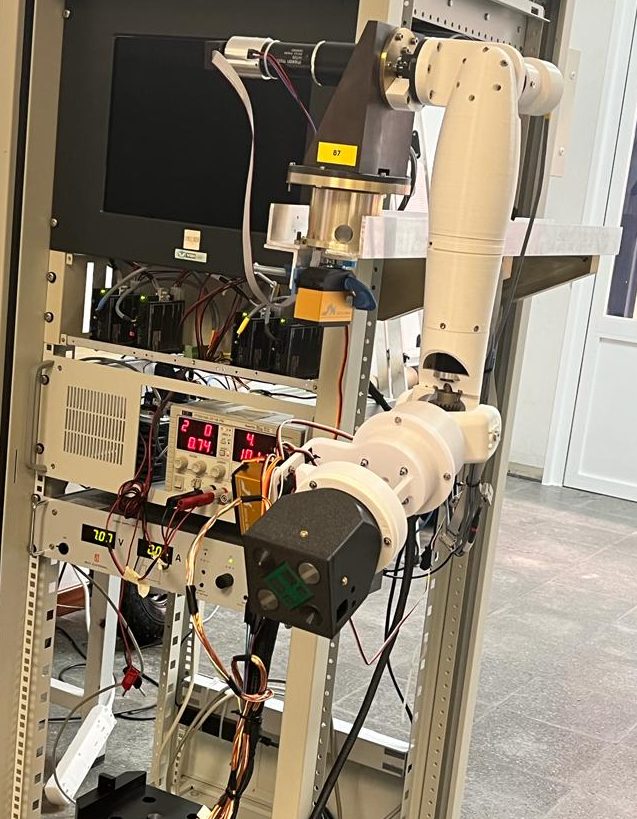
Images of the demonstrators used to validate the interface: swappable tools on secondary modules, the primary module that powers them and the robotic-arm bench used for autonomous tool exchange.


In drones, ground robots, underwater vehicles, modular satellites or harsh industrial environments, connectors degrade from dust, water, mud, vibration, corrosion, pressure, extreme temperatures or repeated mating cycles. And in autonomous systems, coupling must happen without human intervention.
We are not a generic wireless charger. The value lies in combining power, data, latching and ruggedness where connectors fail. Dual-use, B2B/OEM positioning.
Rugged docking with no exposed contacts to operate in mud, dust, rain and vibration, with no human handling.
Institutional origin and legitimacy at INTA. A market for technology validation and high value.
Docking for autonomous underwater vehicles: recharge and data without recovering the vehicle and with no exposed contacts in the marine environment. Line under development with naval integrators.
Robots, AMRs, automated laboratories and industrial automation: tool changes and charging stations in dusty, humid or chemical environments.
Sterilisable interface with no exposed connectors: keeps the sterile barrier in couplable equipment and devices.
Ports, mines, warehouses and logistics. Selective focus on special vehicles, not mainstream automotive or generic EV charging.
From evaluation kit to OEM module integrated in the platform. Model: evaluation kits, NRE engineering, OEM modules and field-of-use licences.
150-200 W module with bidirectional serial data, magnetic latching and IP67/68 versions for tools, payloads and charging stations.
Up to 2.5 kW with data and reinforced latching; subsea (pressure) and ruggedised (MIL-STD-810) versions for unmanned-system docking.
≤ 10 W, miniaturised, rad-tolerant components and ECSS qualification (vibration, thermal vacuum, EMC, radiation).
Pair + electronics + software + support to test power, data and latching on your own platform; feasibility studies and custom integration projects.
The relevant comparison is not against wireless chargers, but against power, data and coupling interfaces for critical environments.
| Criterion | InductaLink (Touch & Play) | Physical connectors / pogo pins | Robot wireless chargers | Space interfaces (SIROM, HOTDOCK) |
|---|---|---|---|---|
| Energy | Yes, adaptive magnetic flux | Yes, by contact | Yes | Yes, usually by contact |
| Data | Yes, bidirectional | Yes, by contact | Limited | Yes, mature protocols |
| Mechanical latching | Yes, magneto-mechanical | External | No | Yes, highly developed |
| No exposed contacts | Key advantage | No | Yes | Not always |
| Data transmission security | High: localised contact link | High, but with exposed contacts | Low/medium: interceptable RF link | High, by contact |
| Dust, water, contaminated environments | Designed for it | Degrade | Partial | Architecture-dependent |
The invention protects a split-transformer interface: two modules with a ferromagnetic core that, on contact, close the magnetic circuit and transfer energy and data with no electrical contacts. The claimed novelty is asynchronous control: the transmitter adjusts pulse width and cadence in real time according to the state reported by the receiver. It also covers bidirectionality and releasable magnetic latching.
The spin-off is structured around a field-of-use licence (defence, aerospace, autonomous robotics and subsea), with access to know-how, prototypes and support from the inventor team.
If you work on unmanned systems, robotics, space platforms, subsea or harsh industrial environments, let's talk about a pilot or an integration kit.
Also open to conversations with deep-tech, dual-use and industrial-hardware investors.